LGBTQ situation in Ukraine in first half of 2026
Since the beginning of 2026, there have been no noticeable changes in the legislation related to the protection of LGBTQ rights in Ukraine. The draft of the new Civil Code, submitted to the Verkhovna Rada by a group of MPs led by the Speaker of the Verkhovna Rada Ruslan Stefanchuk , who is its main initiator and lobbyist, caused great concern and a sharp negative reaction from both the LGBTQ movement and civil society as a whole. This draft law, despite the stated goals of its adoption, contradicts modern European standards in many areas and, in particular, worsens the current legal situation of same-sex family partners. Under pressure from Ruslan Stefanchuk, the Verkhovna Rada adopted it in the first reading, but after a series of mass public protests by civil activists and comments from international organizations and foreign partners of Ukraine, its authors stated that they were ready to make significant changes to it and removed scandalous innovations.
Protests against the draft Civil Code and demands to legalize registered civil partnerships for same-sex couples have become the main topic of mass public LGBTQ events, which in 2026 became the largest since the start of the full-scale Russian invasion. The Ukrainian government and president have made several public statements in support of equal rights for LGBTQ people, but the adoption of the necessary laws is being slowed down in parliament due to the position of conservative deputies and non-public lobbying by ultra-conservative Ukrainian churches.
Another public opinion poll by the Kyiv International Institute of Sociology, however, found that the vast majority of Ukrainian society as a whole, including most believers of Ukraine’s major religious denominations, generally support legal equality for LGBTQ people.
In 2026, the National Police and local authorities demonstrated a more consistent position on ensuring freedom of peaceful assembly to support the rights of the LGBTQ community and protection of LGBTQ events from their aggressive opponents from far-right groupings. However, during the spring wave of protests against the adoption of the draft new Civil Code, in many cities the police resorted to unjustified restrictions on freedom of assembly and expression.
1. Generalized socio-political situation
Legislation and judiciary
Since the beginning of 2026, there have been no significant changes in Ukrainian legislation regarding the protection of LGBTQ rights. Bills on civil partnership 9103 and 12252 , as well as Bill 13597 on amendments to anti-discrimination and criminal legislation, which had been previously submitted to the parliament for consideration, have not yet been considered.
The main event in the field of lawmaking related to the protection of LGBTQ people’s rights was the registration in early 2026 of a draft of the new Civil Code (Bill 14394), the main initiator of which is the Chairman of the Verkhovna Rada of Ukraine Ruslan Stefanchuk. Later, alternative Bills 14394-1 and 14394-2 were registered, which differ little from the first document. This draft law, which was supposed to replace the current Civil and Family Codes, as well as a number of other laws of Ukraine, caused a flurry of criticism and concern from the Ukrainian public and foreign partners of our state, as well as negative comments from the Ministry of Justice, as one that contradicts the stated goals of modernizing Ukrainian civil legislation in accordance with modern European Union standards. In particular, it proposed a new definition of “family member” concept, excluding same-sex partners from their number, contrary to the current Family Code, which actually recognizes family relationships of same-sex couples.
After that, Ruslan Stefanchuk and other initiators of Bill 14394 withdrew it from consideration by the Verkhovna Rada, instead submitting for its consideration almost identical Bill 15150, which was urgently adopted in the first reading. This bill retains all the main shortcomings of the previous one, however, responding to harsh criticism and mass protests from the public, the Speaker of the Verkhovna Rada promised to consider and take into account all comments to it — in particular, to preserve the definition of a family member contained in the current Family Code. Since more than 20 thousand proposed amendments were submitted to Bill 15150, its vote in the second reading is expected no earlier than autumn 2026 or even later. The adoption of Bill 15150 effectively nullifies Bill 12252 on civil partnerships, as the last amends the current Family Code, which, according to Bill 15150, should be replaced by a new Civil Code. Bill 9103 is blocked at the level of the parliamentary Legal Policy Committee, which refuses to consider it, thereby blocking its consideration by the Verkhovna Rada.
In the field of judiciary law, the Supreme Court made an important decision of February 25, 2026, refusing the homophobic public organization Civic Movement “All Together!” in reviewing the decisions of the Desnyanskyi District Court of Kyiv and the Kyiv Court of Appeal on the recognition of de facto family relations between same-sex partners. The Supreme Court decided that these decisions did not in any way concern the rights, freedoms, interests and obligations of the NGO “All Together!”, and current Ukrainian legislation authorizes the court to ascertain the fact of cohabitation of two people as one family that has legal consequences.
At the same time, it is important to stress that these court decisions do not mean the recognition of marriages or registered partnerships concluded abroad, and grant partners extremely limited rights provided for by current Ukrainian legislation for persons who live together, have mutual rights and obligations, but are not married to each other. To ascertain the fact of cohabitation as a family, partners are forced to prove to the court the existence of family relations between them, and the court may refuse them such recognition, which was demonstrated by the decision of the Industrial District Court of Kharkiv in March 2026. The court refused the plaintiffs — same-sex partners, one of whom is a military serviceman — to recognize the fact of their living together as a family due to insufficient evidence. The Kharkiv Court of Appeal upheld this decision of the court of first instance.
In January 2026, the Kharkiv District Administrative Court issued a decision ordering one of the military enlistment centres (MEC) in Kharkiv to exclude a person who had officially changed gender from male to female from the military registration of persons liable for military service. The MEC refused to do this, noting that such a basis for exclusion from military registration is absent in the current legislation, but the court disagreed with this statement pointing out that, due to the official change of gender, the plaintiff now does not belong to the category of persons who are obliged to register for military service.
State and law enforcement agencies, Armed Forces of Ukraine, local self-government
At a meeting with Volodymyr Zelenskyi regarding the cultural initiative “Tysyachovesna,” the head of the NGO “Ukrainian LGBT+ Military for Equal Rights” Oleksandr Demenko, a veteran of the Azovstal defence, asked him whether cultural products are needed now to increase tolerance and inclusion of LGBTQ people in Ukraine. The President of Ukraine stated that “[…] we need to talk openly with society about everything, and this is absolutely normal. We all here, we are defending the state, we are the same and have absolutely equal rights — despite any, I don’t know, prejudices of people from the XV century. We along with you are modern people.” When asked to talk to the Chairman of the Verkhovna Rada Ruslan Stefanchuk about the homophobic provisions of his draft of the new Civil Code, President Zelenskyi noted that adult politicians in Ukraine have something to learn from the younger generation and that he supports the initiatives of the movement represented by Oleksandr Demenko.
The most consistent position on the protection of LGBTQ rights in 2026 was demonstrated by the Ministry of Justice of Ukraine. In its response to the draft of the new Civil Code (Bill 14394), it directly pointed out to its authors the inadmissibility of restricting the rights, which same-sex couples have under current legislation, and the need to introduce registered civil partnerships available to same-sex couples in accordance with the ECtHR decision in the case Maymulakhin and Markiv v. Ukraine. All these comments were transferred to Bill 15150, which replaced the previously introduced Bill 14394. Also the issues of protecting LGBT rights were duly taken into account in the draft of the updated National Strategy on Human Rights until 2035, which the Ministry of Justice submitted for public discussion in March 2026.
A representative of the Directorate for Strategic Planning and European Integration of Ukraine of the Ministry of Justice joined the European Commission’s expert group on LGBTIQ+ equality as an observer at a meeting dedicated to the presentation of the EU LGBTIQ+ Equality Strategy 2026–2030 as well as the practices and achievements of EU member states in this area.
The Ministry of Youth and Sports of Ukraine gave a negative opinion on the provisions of the draft Civil Code (Bill 15150, Article 1495), which provides for the invalidation of a marriage with a person who has changed gender, and recalled the need to take into account human rights and the principle of non-discrimination when applying customs in civil law.
The Office of the Vice Prime Minister for Euro-Atlantic Integration has included representatives of LGBTQ organizations in thematic subgroups on the implementation of the Roadmap on the Rule of Law in preparation for Ukraine’s accession to the European Union. However, the implementation of measures to reform Ukrainian legislation envisaged in this document is hampered at the level of the Verkhovna Rada, whose leadership constantly postpones consideration of relevant bills and avoids participation in the work of the aforementioned thematic subgroups.
In the annual report on the state of observance and protection of human and civil rights and freedoms in Ukraine in 2025, one of the sections of which is dedicated to the protection of LGBTIQ+ people’s rights, the Commissioner for Human Rights of the Verkhovna Rada of Ukraine once again recommended the parliament to adopt bills on the criminalization of hate crimes on SOGI grounds and to introduce registered civil partnerships available to same-sex couples, as well as to include victims of criminal offenses motivated by intolerance based on sexual orientation and gender identity in the list of persons entitled to free secondary legal aid. The Commissioner’s special attention was drawn to cases of discriminatory and abusive treatment of transgender persons by Ukrainian border guards, therefore he recommended that the State Border Service of Ukraine ensure systematic training of staff on observing equal rights and freedoms and non-discriminatory treatment of persons, in particular on grounds of sexual orientation and gender identity.
The Council of Europe Office in Ukraine reported that in February 2026, 20 representatives of the Ministry of Defence participated in a training on combating discrimination and sexual harassment in the Armed Forces, where much attention was focused on protecting the rights of women and vulnerable groups, particularly LGBTI+ persons.
The national media regulator — the National Council of Ukraine for Television and Radio Broadcasting — has published recommendations for the media on preventing hate speech and discrimination, which pay great attention to the issues of monitoring and protecting against hate speech based on sexual orientation and gender identity.
The Ambassador of Ukraine to the Republic of Ireland, together with other Ukrainian and foreign diplomats, participated in the Dublin Pride Parade, where she spoke with the country’s Prime Minister.
The Ministry of Social Policy, Family and Unity of Ukraine demonstrated symbolic support for the LGBTQ community by placing a post on its Facebook page during Pride Month (June 2026) in support of equality, dignity and respect for LGBTQ people.
A similar statement was posted on the official web resources of the Kyiv City State Administration. The organizers of KyivPride reported on constructive cooperation with the city administration and police in holding and protecting pride events; there was also a noticeable improvement in cooperation with local authorities and police in holding LGBTQ events in Odesa and Lviv. The member of Verkhovna Rada Yevhen Petrunyak reported that he had sent a parliamentary appeal to the Mayor of Lviv proposing to ban LvivPride. However, he received a response “with references to the Constitution, the European Convention on Human Rights, the Law on the Legal Regime of Martial Law, and the Code of Administrative Procedure” that the Lviv City Council only “offered the organizers alternative formats” for holding the event, but did not apply to the court to ban it when they refused, and instead turned to the police with a request to ensure public order during the rally. As in Kyiv, the National Police provided reliable protection for pride events in Lviv from their aggressive opponents.
At the same time, local authorities and police tried to prevent a public action in support of LGBTQ rights (a protest rally against the draft of the new Civil Code) in May 2026 in Lutsk, organized by the NGO Insight. The City Council’s Department on Appeals verbally refused to accept the application for the event, an officer of the Security Service of Ukraine dissuaded the organizers from holding it on the appointed day due to the coincidence with the birthday of the local metropolitan of the Orthodox Church of Ukraine, and police representatives demanded that the event be cancelled due to the impossibility of guaranteeing its safety. Thanks to the organizers’ persistence, the action nevertheless took place at the scheduled time, and the police provided protection for it from possible attacks. However, after the demonstration ended, a police officer filed a report against its organizer for violating the procedure for holding rallies and assemblies, citing the decision of the Volyn Oblast Defence Council of August 27, 2024. The court closed the proceedings in the administrative offense case due to the fact that the decision of the Defence Council mentioned in the police report had lost force at the time of its preparation, but did not assess the actions of law enforcement officers and local authorities who tried to unreasonably restrict the constitutional right of citizens to peaceful assembly.
Known for his consistently homophobic and transphobic stance, Ivano-Frankivsk Mayor Ruslan Martsinkiv has recently shown some softening of his rhetoric towards LGBTQ people. In an interview with RBC-Ukraine, he agreed with the journalist that “public opinion leaders, especially during a major war, should refrain from commenting on certain topics on which there is no consensus in society, such as the rights of the LGBTQ community,” but complained that journalists constantly ask him about it. “I emphasize once again: I am for family values. I am not against any group of people. But I believe that today such ideology harms the Ukrainian state, our nation,” he said, expressing his current attitude towards the movement for the rights of LGBTQ people.
Politics, mass media, and society
The debates surrounding the draft of the new Civil Code have demonstrated that the issues of human rights protection and Ukraine’s European integration are becoming increasingly important for Ukrainian society and politics, as much as possible within the context of the ongoing war. Apparently, such a sharp and active negative reaction of civil society to the reactionary, archaic and discriminatory norms of this bill was unexpected for its authors and forced them to promise to reconsider its key innovations — in particular, those related to the restriction of LGBTQ rights. Judging by the reaction of MPs to the public protest, most of them, having supported Bill 15150 in the first reading, did not realize its specific content, but simply succumbed to the persuasion of its main author, the Chairman of the Verkhovna Rada Ruslan Stefanchuk .
Judging by the statements and remarks of the Verkhovna Rada members, most MPs neither support initiatives to protect the rights of LGBTQ people nor actively resist to such legislative proposals, although in general they consider Ukrainian society to be quite conservative and therefore try to avoid discussing such topics altogether. In fact, only Inna Sovsun MP takes an active position on the protection of LGBTQ people’s rights although she is, in principle, supported by a rather small group of colleagues from the factions of the Holos and Servant of the People parties. However, the group of active opponents of equality for LGBTQ people, which has formed around MPs Ihor Fris and Yevhen Petrunyak, is also small. Most deputies agree that these issues will need to be resolved as a part of Ukraine’s accession to the EU, but prefer to postpone this until the end of this process. This opinion is shared by Ruslan Stefanchuk, who does not want to legalize civil partnerships available to same-sex couples within the framework of his draft Civil Code, believing that such an idea will not receive the support of the parliamentary majority — at the same time, he does not object to considering a separate bill on this issue.
Prominent Ukrainian conservative politicians, excepting MPs Ihor Fris and Yevhen Petrunyak as well as the Chairman of the Dnipropetrovsk Oblast Council Mykola Lukashuk, refrained from commenting on LGBTQ issues in 2026. Yevhen Petrunyak , as already mentioned, sent a parliamentary appeal to the Lviv Mayor Andrii Sadovyi and the head of the Lviv Oblast Military Administration Maksym Kozytsky, regarding the ban on a public mass event within LvivPride 2026, which, however, took place safely under effective police protection. Like Ihor Fris, he regularly expresses extremely negative and uncompromising views towards the LGBTQ community on his social media pages. Mykola Lukashuk, as in the past year, again spread disinformation that “the EU requires Ukraine to legalize same-sex marriage” and again protested against this fictitious condition for Ukraine’s accession to the EU.
Police protection remains a mandatory condition for holding public LGBTQ actions, as opponents of the LGBTQ movement from the far-right groups do not abandon threats and attempts to disrupt them by force. The main contingent of aggressive opponents of the LGBTQ movement consists of teenagers, as a rule dressed in black and hiding their faces under masks or balaclavas, who act under the leadership of older comrades. This is exactly what most of the March of Tradition participants — the counter-action to the Kyiv March of Equality 2026 — looked like. Alongside them was a smaller group of peaceful opponents of the LGBTQ movement from the so-called “Pro-Family” activists headed by the leader of the prominent homophobic movement “All Together!” Ruslan Kukharchuk. In 2026, these two components of the homophobic counter-action taken together were clearly inferior to the number of participants in the Equality March which became the largest since the beginning of the full-scale Russian invasion.
The tactics of intimidation of the LGBTQ movement and its allies are also manifested in posting threats against them on social networks and pasting homophobic leaflets in their offices — this was noted in 2026, particularly, in Ivano-Frankivsk (the local office of the NGO Insight) and the Kyiv bookstore Sens.
Some businesses and government agencies that in previous years demonstrated their solidarity with the LGBTQ movement during Pride Month did not do so in 2026 — however, new participants joined the campaign instead. Their total number is difficult to estimate, but it amounts to three-digit numbers. Among the notable companies that joined the campaign of solidarity with the LGBTQ community in 2026 was BlaBlaCar — the world’s leading ridesharing platform, operating in Ukraine since 2014. The Ukrainian scout movement Plast, which is a very conservative organization in Ukraine itself, was embarrassed by the unexpected support of Pride Month in Ukraine from its colleagues of Plast Canada.
The attention of both supporters and opponents of the LGBTQ movement was attracted by the act of a girl named Yuliana Kaznodii, who demonstratively wiped her feet on a rainbow flag at a counter-action to the Equality March in Kyiv, as well as the reaction to it from her employer — as it turned out, she, as a private entrepreneur, worked as a manicure specialist in the G×Bar Kyiv beauty salon. Upon learning of her actions, the salon’s management published a comment stating that such actions contradict the company’s ethical principles, so it ceased cooperation with Yuliana Kaznodii. In turn, the girl wrote in Threads that, although she had a different vision of the institution of the family, she did not intend to humiliate anyone, and apologized for her act, but later deleted this post. The public opinion on these events was divided: some clearly supported the girl, some — the reaction of the business. The legality of the G×Bar management’s actions also remained unclear — some lawyers stated that they were ready to defend her rights in court if she decides to file a lawsuit against the company. As far as is known, however, Yuliana Kaznodii did not do this.
Regarding LGBTQ issues, traditional Ukrainian mass media and online resources in 2026 paid a lot of attention to the topics of protests against the draft of the new Civil Code, the legalization of registered civil partnerships, and the preparation and holding of pride events. In general, the coverage of this topic, in our opinion, can be described as satisfactory, but it is noticeable that journalists often simply retell someone’s statements and assertions without any comments, not trying to check their factual accuracy. For example, when retelling the statements of Ruslan Stefanchuk and other authors of the draft Civil Code that it allegedly does not change the legal status of same-sex partners in any way, they did not mention that this was not true, although this information was easily accessible thanks to the mass protests against this bill.
Experts from the Institute of Mass Information (a media NGO) analysed how LGBTQ issues are covered in popular Ukrainian Telegram channels, which have become an important source of information for a wide online audience. They concluded that “LGBTQ+ rights are almost absent from the agenda of the largest Ukrainian Telegram channels. When this topic does appear, it is mostly as a pretext for scandal, sensation, or manipulation, rather than as a human rights issue. The Equality March was presented by most channels as a confrontation between two sides, with almost no explanation of the demands of its participants.” They also noted the spread of Russian homophobic propaganda without any comments on its credibility..
New important data on the attitude of Ukrainian society to LGBTQ issues were obtained in a sociological study conducted in May-June 2026 by the Kyiv International Institute of Sociology (KIIS) at the request of the NGO Fulcrum. It confirmed the general conclusions of previous similar surveys, which were conducted in recent years by KIIS sociologists at the request of Nash Svit Center and the National Democratic Institute, regarding a confident trend of improving the attitude of Ukrainians towards LGBTQ people and the protection of their rights. In particular, in 2026, about three quarters (74%) of the respondents supported (fully or rather) the prohibition of discrimination against LGBTQ people, more than a half (54%) — the legalization of registered civil partnerships for same-sex couples, and 46% — the right of same-sex couples to adopt children.
The most interesting is the analysis of the received responses taking into account the religious beliefs of the respondents. Despite the extremely hostile negative attitude of the largest Ukrainian churches leadership towards LGBTQ people, ordinary believers demonstrated much more tolerant views. The ban on discrimination against LGBTQ people was supported by 81% of Christians who do not belong to any church, 78% of believers of the Orthodox Church of Ukraine, 72% of believers of the Ukrainian Orthodox Church (Moscow Patriarchate), 71% of Greek Catholics, and 44% of Protestants. The legalization of registered partnerships for same-sex couples was supported by 63% of non-denominational Christians, 56% of OCU believers, 44% of UOC believers, 46% of Greek Catholics, and only 25% of Protestants. Even the right to adoption for same-sex couples was supported by 54% of non-denominational Christians, 47% of OCU believers, 41% of UOC believers, and 37% of Greek Catholics, but only 17% of Protestants. It can be stated that believers of Ukraine’s largest denominations (Orthodox and, to a lesser extent, Greek Catholics) in their attitude towards the recognition and protection of LGBTQ people’s rights demonstrate views typical for Ukrainian society as a whole. Only Protestants — which in Ukrainian realities means the so-called Evangelical Christians (Baptists, Adventists, Pentecostals) — demonstrate a much more conservative and unfriendly attitude. However, it should be noted that they make up only about 2% of Ukrainian society as a whole as well as among the respondents to this survey.
Churches and religious organizations
In recent years, there has been a tendency on the part of leading Ukrainian churches to refrain from public statements on LGBTQ issues, while maintaining ultra-conservative views and non-public lobbying against the government taking any steps to protect the rights of LGBTQ people. In the first half of 2026, for the first time, no statements on LGBTQ issues were documented from the All-Ukrainian Council of Churches and Religious Organizations (AUCRO), which unites the largest and most influential religious associations in Ukraine, or from individual religious structures within it.
It is worth noting that the Ukrainian Orthodox Church (Moscow Patriarchate), allegedly still the largest church in Ukraine, is currently experiencing a deep internal crisis. It has completely lost support from the state authorities and suspended participation in the activities of the AUCCRO. Its official representatives — in particular, Metropolitan Anthony (Pakanych) — condemn the Ukrainian authorities for the decision to join the EU, and their former colleagues in the AUCCRO — for supporting this course and a passive position regarding the political and legal standards of the European Union to protect the rights of LGBTQ people. However, the refusal of the UOC to break the canonical connection with the mother Russian Orthodox Church, which actively supports the war against Ukraine, has led to the fact that it has completely lost influence on Ukrainian society and the authorities.
The new leader of the tiny, marginal Ukrainian Orthodox Church (Kyiv Patriarchate), Patriarch Nicodemus, issued a statement on June 22 strongly condemning the Equality March in Kyiv. He led the remnants of this church after the death of Patriarch Filaret, but, unlike his predecessor, enjoy no authority or influence in Ukrainian society and the religious community.
The main open and active enemy of the Ukrainian LGBTQ movement is the religious activist (Pentecostal) and journalist Ruslan Kukharchuk, who heads the ultra-conservative movement “All Together!” created by him, the main goal of which is to resist the liberalization and modernization of Ukrainian society in general and, in particular, the fight against the protection of LGBTQ people’s rights. He does not enjoy authority among the religious associations belonging to the AUCCRO and does not cooperate with them, but participates in the work of alternative Protestant associations (particularly, the Ukrainian Interchurch Council), where he actively promotes a homo / transphobic agenda — however, unlike the AUCCRO, they represent small religious groups and have no influence on society and state authorities.
As for the activities of the AUCCRO, it has significantly increased its international activity, and in June 2026 conducted a number of visits to various countries and meetings with representatives of religious, governmental and international organizations. In particular, during the visit to Brussels, the AUCCRO delegation met with the European Commissioner for Enlargement Marta Kos. At this meeting, representatives of leading Ukrainian churches and religious associations “stressed that the Ukrainian people had chosen the European path of development through two popular uprisings and noted that Ukrainian churches and religious organizations, as an integral part of civil society, support Ukraine’s accession to the European Union and are interested in cooperating with international partners who share this commitment.”
This certainly does not mean that the leadership of religious associations represented in the All-Ukrainian Council of Churches and Religious Organizations has reconsidered their implacably hostile attitude towards LGBTQ people, but the careful avoidance of discussing this topic and the lack of reaction to accusations from ultra-conservative forces of liberalizing this attitude demonstrate certain changes in the policy of leading Ukrainian churches on LGBTQ issues. It seems that they are trying not to conflict with Ukraine’s course towards joining the EU as soon as possible and have understood the inevitability of certain political and legal steps to protect LGBTQ rights within this process. This is also facilitated by their contacts with representatives of foreign churches and religious organizations, during which they invariably receive support and assistance from liberal churches and frankly unfriendly attitude from ultra-conservative ones, which are inclined to a pro-Russian position.
LGBTQ community
In the first half of 2026, the LGBTQ movement became more visible to Ukrainian society due to mass public protests against the draft of the new Civil Code and other actions in cities such as Odesa, Kyiv, Kharkiv, Lviv, Lutsk, Dnipro, Vinnytsia, Uzhhorod, etc. The most numerous and visible were the Pride March in Odesa on May 17, which was the first since the beginning of the full-scale Russian invasion, and the Equality March in Kyiv on June 21, which happened to be the largest in recent years (about 5 thousand participants). Their main topics were also protests against the draft of the new Civil Code as well as demands for the adoption of legislation on hate crimes and registered civil partnerships.
This topic has also been a leading issue in the advocacy activities of the Ukrainian LGBTQ movement within cooperation with state bodies, international organizations and foreign partners of our country, especially within the framework of the process of preparing Ukraine for accession to the EU. The advocacy efforts of the LGBTQ movement forced the authors of the draft new Civil Code to pay attention to its obviously discriminatory provisions regarding same-sex family partners, and at a meeting with members of the initiative group, its main initiator, the Speaker of the Verkhovna Rada Ruslan Stefanchuk, promised to take into account their proposals and, by the second reading, to remove from his draft articles that worsen the legal protection of same-sex partners compared to the current legislation.
The LGBTQ movement is becoming increasingly visible in Western Ukraine, in cities such as Lviv, Lutsk, and Ivano-Frankivsk, where it previously faced violence from far-right groups and an openly unfriendly attitude from local authorities and police. Attempts to block any LGBTQ events and intimidation of activists by their aggressive opponents continue, but now the police are more conscientious in their duties of protecting them, and local authorities have begun to treat the LGBTQ movement more tolerantly. LvivPride 2026, which took place on June 7 in the very centre of the city, near the Opera House, attracted a lot of attention -– it was a kind of testing the readiness of local authorities and police to ensure freedom of peaceful assembly for the LGBTQ community in the largest city in Western Ukraine — a well-known, main centre of the ultra-conservative Ukrainian Greek Catholic Church and radical nationalist movements. The successful holding of the event under effective police protection, despite threats and demands for its cancellation from enemies of the LGBTQ community, demonstrated positive changes in socio-political attitudes towards LGBTQ people in this region as well.
Among other advocacy actions of the LGBTQ movement, it is worth mentioning the trial in Kharkiv on the recognition of de facto family relationships between same-sex partners, one of whom is an active military serviceman. Despite its unsuccessful outcome (the court found the evidence provided by the plaintiffs that they lived as one family insufficient), it drew the attention of the press and the public to the problem of recognizing and protecting the rights of same-sex family partners, who, together with the entire nation, defend Ukraine from Russian aggression, but are deprived of the basic rights and opportunities available to heterosexual couples.
One of the most important aspects of LGBTQ organizations activities remains humanitarian and psychological support for those affected by the war — unfortunately, funding for the humanitarian component and the LGBTQ movement as a whole has been noticeably reduced in recent years. However, LGBTQ organizations support the work of several temporary shelters and are constantly raising funds for the needs of the Ukrainian army.
In early June, Kyiv hosted a three-day Trans Forum 2026, where activists and allies of the trans*community discussed existing problems and ways to solve them. Transgender community activists drew attention to the vagueness of the criteria used by doctors when diagnosing “Transsexualism” that is necessary to begin the official gender transition procedure. According to them, this complicates the procedure and creates corruption risks, since establishing such a diagnosis depends on the subjective assessment of the doctor. Also relevant is the problem that the official change of gender is not regulated in any way in matters of entering or removal from military registration, and sometimes transgender persons have to go to court for this, as described in the first section of this report. Transgender people who still serve in the Ukrainian army also face discrimination and legal restrictions — since the diagnosis of “Transsexualism” refers to mental disorders, they officially cannot hold ranks and positions of command and are deprived of access to state secrets.
2. VIOLENCE, DISCRIMINATION AND OTHER VIOLATIONS OF LGBTQ RIGHTS
(i)In this section, the number of documented violations of LGBTQ people’s rights may apparently exceed the number of cases because some cases involve several violations.From January to June 2026, the monitoring network of Nash Svit Center documented 26 cases of actions based on homophobia / transphobia, discrimination and other violations of rights on SOGI grounds in Ukraine. The distribution of documented cases by region was as follows (please see Table 1):
Table 1
Interaction with individuals or groups
The largest number of cases (11) concerned homophobic and transphobic acts by individuals or groups. According to the OSCE classification, 6 of them can be characterized as hate crimes, 5 as hate incidents, and one of these incidents also involved hate speech.
The following types of violations were noted (please see Table 2):
Table 2
One case could include several types of violations, so the sum of the indicators in the table exceeds the total number of cases.
As in the past year, the level of aggressive actions by radical far-right groupings against LGBTQ centres / events or activists remains significant.
Case 2445
“On February 21, about seven in the evening, a group of aggressive young men aged 17-20, most of whom were wearing balaclavas, attacked my 18-year-old daughter. About 15 people on the street near our home beat my child because of her dress and shouted offensive homophobic remarks at her: “queer, fucking lesbian, burn in hell.” The child is in the hospital with a concussion. An application was submitted, but no action was taken by the police,” — this is how the mother of a victim from Zhytomyr described the events and the lack of reaction from the police.
Case 2463
On May 17, about 18:30, near the Dytyachyi Svit shopping centre in Khmelnytskyi, unknown men provoked and attacked participants of a peaceful protest against the adoption of the new Civil Code: the attackers insulted them in connection with their sexual orientation (“faggot”), teared down posters, and tried to physically pull some protesters out of the group. The police were present at the scene but they did not intervene.
Case 2466
After the owner of the GxBar Kyiv beauty salon severed business relations with her employee due to the latter’s homophobic position (she trampled on the rainbow flag during a counter-Pride action on June 21, 2026), the establishment began receiving massive homophobic insults and threats from unknown individuals on social networks (preparation was observed in the right-wing Telegram channel Catharsis).
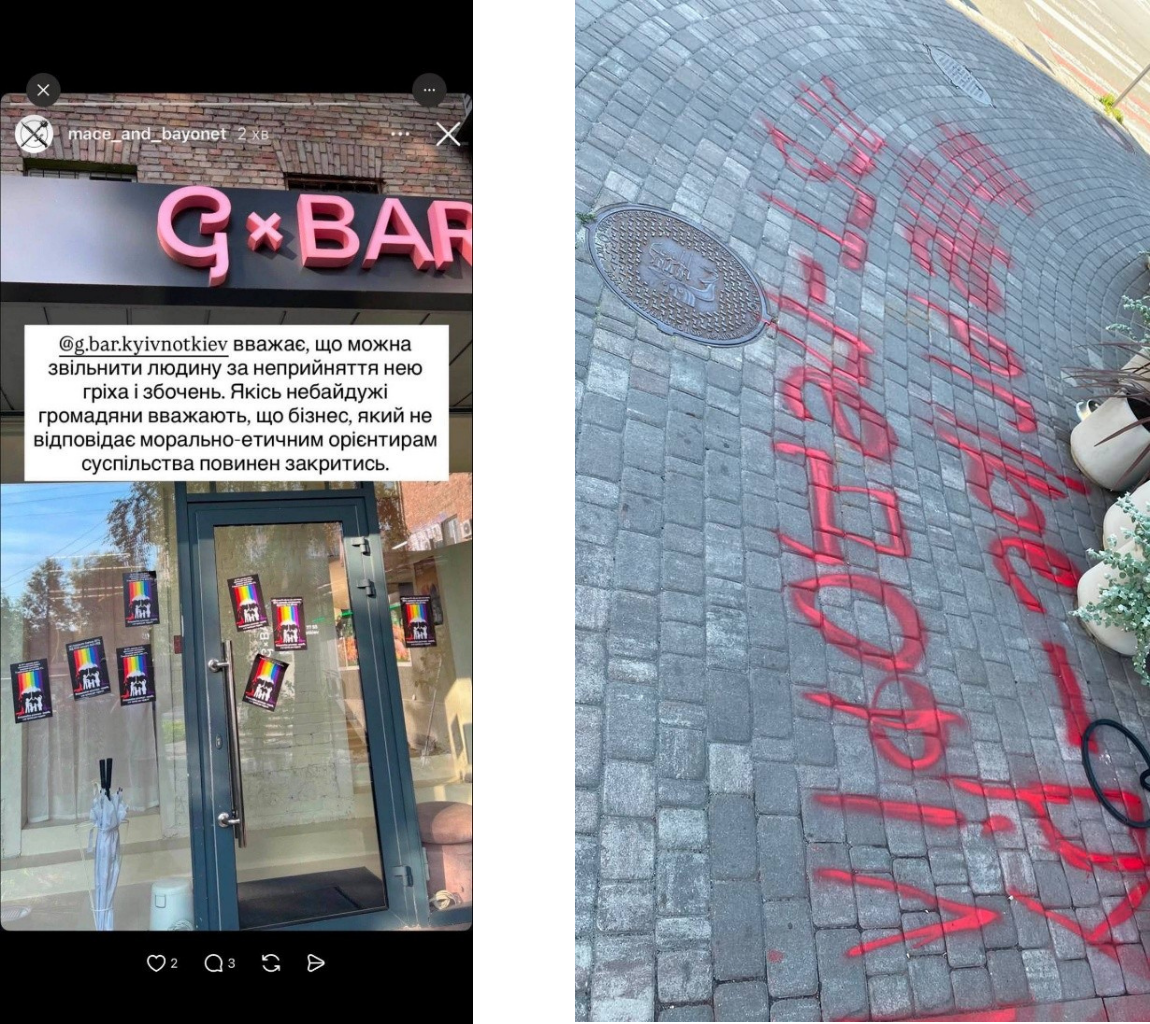
On June 26, homophobic stickers appeared on the glass facade of the salon, which had previously been seen in other locations (in particular, the case of the attack on the Sense bookstore in October 2025), and later a young man entered the establishment and spilled an unknown substance inside which made the salon staff feel sick and they were forced to leave the premises. On June 28, unknown persons made a homophobic inscription with paint on the sidewalk in front of the establishment.
Interaction with law enforcement agencies
In 16 cases, the interaction of victims with law enforcement agencies was noted (calling the police, filing reports of offenses, conducting investigative actions, etc.). 10 of them included cases of violations of LGBTQ people’s rights by law enforcement officers (please see Table 3). Meanwhile, during the same period last year, violations were recorded in only 3 out of 10 cases of interaction with law enforcement officers. Thus, the share of interactions during which violations were recorded doubled.
Table 3
Most of the cases concerned violations of the rights to freedom of peaceful assembly (6) and freedom of expression at these assemblies (4). All these peaceful protests, which took place from April to June in many cities across the country, were dedicated to opposing the adoption by parliament of the discriminatory new Civil Code of Ukraine. The geography of violations by the police included Kyiv, Cherkasy, Lviv, Khmelnytskyi, and Lutsk. Some of these violations concerned unlawful requirements regarding the content of posters and symbols on LGBTQ themes.
In the video, the Lviv police attempt to censor LGBTQ-themed posters during a protest against the draft Civil Code.
In Lutsk, an administrative protocol was drawn up against the organizer of the action for allegedly violating the procedure for holding assemblies / rallies, which was successfully appealed in court.
A significant part (4) of violations by the police consist in unsatisfactory response to reports of homophobic / transphobic crimes.
Case 2453
In April of this year, a gay man, who was threatened by perpetrators with the dissemination of personal information unless he pay them several thousand hryvnias, filed a complaint with Lviv District Police Department #1. He was refused the opening of proceedings — allegedly “the matter was too small.”
Case 2461
On May 10, an attack was committed on LGBTQ activist Olena Shevchenko and her colleague in Ivano-Frankivsk immediately after a peaceful action in which they participated. The police initially kept them waiting for two hours until they decided that they could accept the application. Accepting the application was also quite strange. The victim describes it this way: “[…] four different police officers came to us in turn, who had to be informed on the details of the attack, each time from the beginning. They listened and left, then a new person would came in and asked the same thing again. The police officer who started writing the report tried to assure us that there was no organized attack, these were random people, there was just a scuffle, that perhaps our posters provoked them; she called the posters from the action ‘garbage.’ This psychological pressure continued for 4 hours with a refusal to provide a copy of the testimony, take a photo of the explanation and provide the registration number. The situation changed only after it became known to public.”
Violations in the Armed Forces of Ukraine (military offenses)
In the first half of 2026, 5 cases of violations of rights on SOGI grounds were documented in the Armed Forces of Ukraine (please see Table 4).
Table 4
Only one of the five cases turned out to be public — it was reported by the NGO “Ukrainian LGBT+ Military for Equal Rights” and concerns physical violence, humiliation, and driving to suicide, in particular due to sexual orientation, of a mobilized person in one of the military units.
In other cases, victims did not allow to disclose details of the incidents for fear of secondary discrimination. Two of them involved physical violence by officers of military enlistment centres in Zakarpatska and Odesa oblasts, and two involved the denial of appointments to positions for openly gay serviceman.
Employment
In this area, there was one recorded case (Zhytomyr, February 2026) of a state-owned enterprise employee being forced to resign at his own request, as well as threats to disclose confidential information after the manager became aware of his sexual orientation.
Violations by other government agencies
Two such violations were documented concerning the right of transgender persons to change their documents after the medical stage of trans-transition was completed. In one case, a 34-year-old trans woman, who has temporary asylum in Spain, was denied a change of documents by the Consular Section of the Embassy of Ukraine in Spain in Madrid (case 2454). In the second case, a 22-year-old transgender person, after a reverse trans-transition, was denied a second change of documents by the Solomyanskyi Department of the Kyiv Regional Center for the Protection of Persons with Disabilities (case 2464).
Violations by the occupying authorities in the temporarily occupied territories
In occupied Crimea, Simferopol, we documented one case of a man being held administratively liable by the occupation authorities for the so-called “propaganda of non-traditional sexual relations” in accordance with Article 6.21 of the Code of Administrative Offenses of the Russian Federation. He was fined 100,000 Russian roubles. Since access to the texts of court decisions has been restricted in Russia since May 2026, it is impossible to obtain more detailed information about this case. At the same time, the full names of the individuals who were prosecuted have been published in the open materials on this and other similar cases. Disclosure of such personal data constitutes an intrusion into private life and creates a risk of further persecution of these individuals.
©LGBT Human Rights Nash Svit Center, 2026
E-mail: [email protected]
Website: https://gay.org.ua/
Facebook: https://www.facebook.com/nashsvitcenter
Instagram: https://www.instagram.com/nashsvitcenter
Authors: Andrii Kravchuk, Oleksandr Zinchenkov, Oleh Lyashchenko
Project Manager of Nash Svit Center: Andriy Maymulakhin
When using the report’s materials, a reference to Nash Svit Center is mandatory. This report (in Ukrainian and English) is available on Nash Svit Center’s website.
 |
 |
 |
This report was produced with the financial support of the LSVD and Hirschfeld-Eddy Foundation. The content of this material is the sole responsibility of the author. The views expressed in this material may in no way be taken to reflect the official opinions of the LSVD or Hirschfeld-Eddy Foundation.