LGBTQ situation in Ukraine, January–September 2025
Since the beginning of 2025, no noticeable changes in the legislation related to the protection of LGBTQ rights in Ukraine happened, but the task of adopting relevant laws was included in the Roadmap for Ukraine’s accession to the EU. Similarly, the prohibition of discrimination on grounds of sexual orientation and gender identity has been included in few regulatory documents of various state institutions. The Ukrainian government has demonstrated its readiness to implement the recommendations of its international partners to achieve modern European standards in this area, which cannot be said about the Ukrainian parliament.
The main obstacle to the adoption of laws and policies to protect LGBTQ rights in Ukraine remains the influential leading Ukrainian Christian churches. They try their best to avoid public discussion of these topics, but when forced to respond to events related to LGBTQ issues, they demonstrate sharing the views of Russian propaganda.
With the support of human rights organisations and international partners of our country, the Ukrainian LGBTQ movement is conducting an active advocacy campaign to promote equality and combat violence and discrimination against the LGBTQ community, especially LGBTQ military. The attitude towards them in the Ukrainian military remains problematic, but with the help of the Gender Advisor of the Armed Forces of Ukraine and the Military Ombudsman, the situation is improving.
The National Police, in general, provides effective protection for LGBTQ events from their aggressive opponents belonging to radical right-wing groups, but the situation with the investigation of hate crimes based on sexual orientation and gender identity remains extremely unsatisfactory.
The latest public opinion poll by the Kyiv International Institute of Sociology confirms a steady trend of improving the attitude of Ukrainian society towards the protection of LGBTQ people’s rights.
1. GENERALIZED SOCIO-POLITICAL SITUATION
LEGISLATION AND JUDICIARY
Since the beginning of 2025, there have been no significant changes in Ukrainian legislation regarding the protection of LGBTQ rights. The bills on civil partnership and on amendments to anti-discrimination and criminal legislation, previously submitted to the parliament, have not yet been considered. According to the Rules of Procedure of the Verkhovna Rada of Ukraine, due to the resignation of the Cabinet of Ministers, governmental Bill 5488 (amendments to criminal, administrative and anti-discrimination legislation) was withdrawn. At the same time, a group of MPs registered a new Bill 13597 which differs little from withdrawn Bill 5488.
On February 11, 2025, the Verkhovna Rada withdrawn homo / transphobic Bill 6325 from consideration. Meanwhile, Bill 6327, which proposes to introduce administrative liability for “propaganda of homosexuality and transgenderism,” was included in the agenda of the parliament’s current session — however, given the fate of all similar bills, its consideration and adoption seem extremely unlikely.
On January 23, 2025, the European Court of Human Rights issued a judgment in the case of Sverdlova and Shevchenko v. Ukraine concerning the ban on holding an event on May 25, 2013, on protection of LGBTQ people’s rights, imposed by the decision of the District Administrative Court of Kyiv City of May 23, 2013, following a lawsuit by the Kyiv City State Administration. The ECtHR decided that the plaintiffs were effectively deprived of the opportunity to appeal this decision, which concerned a violation of their right to peaceful assembly, to an appeal court, and found a violation of Article 13 of the European Convention on Human Rights “Right to an effective remedy” in conjunction with Article 14 “Prohibition of discrimination.”
On June 10, 2025, the Desnyanskyi District Court of Kyiv, considering a claim for establishing a fact of legal significance, established the existence of a de facto marital relationship between two men who had previously married each other in the United States. The plaintiffs were same-sex partners who, according to Article 3 of the Family Code of Ukraine, constitute a family. Ukrainian laws allow such permanent partners to enjoy very limited rights of family members, but this requires prior establishment of the fact of their family relationship in court. Similar decisions regarding same-sex partners in Ukraine have been made before, but in this case the court established not only the fact of their family relationship, but also characterized them as a “de facto marital relationship” — which, however, does not mean legal recognition of their marriage concluded abroad.
The homophobic movement “Vsi razom!” (“All Together!”), which did not participate in the case, tried to appeal this decision in the Kyiv Court of Appeal, but was unsuccessful: the court decided that the appeal did not contain arguments referring to specific circumstances that would indicate the impact of the contested court decision on the rights, freedoms, interests and/or obligations of the NGO “Vsi razom!”.
STATE AND LAW ENFORCEMENT AGENCIES, ARMED FORCES OF UKRAINE, LOCAL SELF-GOVERNMENT
The Cabinet of Ministers of Ukraine has approved the Roadmaps for political and legislative reforms, the ultimate goal of which is Ukraine’s accession to the EU. The Roadmap on the rule of law contains a separate Section 3.11 “Discrimination against LGBTIQ people” which includes four actions aimed at addressing these issues:
- development and adoption of a bill on amendments to anti-discrimination, criminal and administrative legislation regarding hate crimes, discrimination and hate speech based on sexual orientation and gender identity;
- introducing registration of hate crimes based on these grounds;
- amending the Law of Ukraine “On Free Legal Aid” in order to ensure the provision of free secondary legal aid to victims of criminal offenses motivated by intolerance on grounds of gender identity and sexual orientation;
- development and adoption of a bill on registered civil partnership.
The deadlines for implementing these measures are 2025-2026. However, based on the previous experience of the legislative work of the government and parliament, the adoption of the relevant draft laws by the Verkhovna Rada within the specified deadlines seems unlikely. The Chairman of the Verkhovna Rada Ruslan Stefanchuk has already stated that currently legislative initiatives on civil partnerships are not a priority. The situation can only be changed by active lobbying of bills on civil partnerships and on amendments to anti-discrimination and criminal legislation by international organisations and Ukraine’s foreign partners.
Unlike the parliament, the Ukrainian government demonstrates a fairly consistent policy of taking into account the rights and interests of LGBTQ people in various spheres of life. Thus, the Strategy for the Development of the Healthcare System for the Period until 2030, approved by an order of the Cabinet of Ministers of Ukraine, provides for the development of the healthcare system on the principles of equal and fair access to quality medical services without discrimination on grounds of sexual orientation and gender identity (hereinafter abbreviated as SOGI).
The National Agency of Ukraine for Civil Service has approved amendments to the General Rules of Ethical Conduct of Civil Servants and Local Government Officials, which stipulate that civil servants and local government officials are obliged to prevent hate speech on a number of grounds, including sexual orientation, in their activities.
The State Service for Food Safety and Consumer Protection became responsible for monitoring the content of job advertisements and their compliance with anti-discrimination legislation in this field — in particular, regarding the prohibition of discrimination on SOGI grounds in employment.
On the occasion of the International Day against Homophobia, Biphobia and Transphobia , the Council for Human Rights, Gender Equality and Diversity under the Ministry of Foreign Affairs of Ukraine, together with the embassies of foreign states, the EU Delegation and the Council of Europe Office in Kyiv, as last year, adopted a joint statement on commitment to ensuring equal rights, protecting human dignity and preventing all forms of discrimination. Deputy Minister Maryana Betsa, along with foreign diplomats, participated in the official opening of LGBT+ Veterans Hub.
On September 25, for the first time in Ukraine’s history, the government appointed an open gay, LGBTQ activist Ivan Verbytskyi, to a high position — Deputy Minister of Culture and Strategic Communications.
The National Council for Television and Radio Broadcasting — the national media regulator — issued a second injunction and subsequently twice fined the website of homo/transphobic movement “Vsi razom!” for publishing materials that spread negative stereotypes, support restrictions on rights, and may provoke violence against the LGBTQ community. NGO “Vsi razom!” appealed both fines (40,000 and 88,000 UAH) in the Kyiv District Administrative Court which has not yet considered these cases.
The Commissioner for Human Rights of the Verkhovna Rada of Ukraine, Dmytro Lubinets, and his office have been quite active in responding to cases of human rights violations and hate speech based on SOGI. In the Report on the State of Observance and Protection of Human and Civil Rights and Freedoms in Ukraine in 2024, the Ukrainian Ombudsman once again drew attention to the need to adopt a law on civil registered partnership and amendments to criminal and anti-discrimination legislation related to the protection of LGBTQ people’s rights. The Commissioner’s Secretariat responded to the refusal of the Kyiv printing house Dominanta-tekstil to print the flag of the organisation “LGBT+ Military and Veterans for Equal Rights,” warning its director that the printing house’s actions “have signs of discrimination against consumers based on sexual orientation and gender identity” that is prohibited by Ukrainian law.
Understanding the danger from their aggressive opponents and the demands of wartime, organisers of public LGBTQ events coordinated their holding with local state and military administrations and the police in advance. As a rule, local authorities and the police tried to dissuade the organisers from their plans, but after lengthy negotiations they would agree to provide their security. However, one of the events planned as a part of KyivPride on the territory of an exhibition centre was cancelled due to pressure from the police and local authorities on the tenants of the pavilion where the event was to take place.
In the vast majority of cases, however, the National Police in 2025 provided effective protection for LGBTQ events in various cities of the country from their aggressive opponents, who, for the most part, consisted of young men, often teenagers, under the banners of far-right organisations. In addition to the already traditional LGBTQ prides in Kyiv and Kharkiv, as well as the Kyiv queer film festival Sunny Bunny, the police, supposedly for the first time, ensured the more or less successful holding of public LGBTQ events in the West of the country — in Ivano-Frankivsk and Lviv.
A blatant case of obviously discriminatory and hostile attitude towards LGBTQ people was demonstrated by law enforcement officers during a police raid on the gay nightclub Dark Room in Kyiv. One of the men, who were detained and accused of disobeying the police and petty hooliganism, appealed the administrative report drawn up against him in the Holosiivskyi District Court of Kyiv. At the trial, he and other victims of police actions spoke about insults, bullying, psychological pressure and physical violence, and other illegal actions against them by the police. The court not only closed the case against this person due to the absence of the body of an administrative offense, but also issued a separate ruling on the illegal actions of police officers. It was brought to the attention of the head of the Holosiivskyi Division of the Main Police Department in Kyiv, the head of the Main Police Department in Kyiv, and the head of the National Police of Ukraine in order to take appropriate response actions in this regard, about which they were to report to the court within one month from the date of its receipt.
In September 2025, the President of Ukraine established the Office of the Military Ombudsman, headed by Olha Reshetylova, who had been previously appointed the Commissioner of the President of Ukraine for the Protection of the Rights of Military Personnel and Their Family Members. In an interview with Radio Kultura, she answered a question about the protection of the LGBTQ military personnel rights: “Provisionally, the staffing list, which we are making, will include an entire unit that will deal with issues of gender equality and anti-discrimination. Of course, the issues of LGBT military personnel and their protection in the army are very important. We must welcome all categories of the population to the Armed Forces. It is clear that LGBT military personnel also defend our state, but due to certain stereotypes in society, they are exposed to oppression, and we have to address this.”
The NGO “Ukrainian LGBT+ Military and Veterans for Equal Rights” (abbreviated as “Military LGBT+”) conducted the first major study on the situation of LGBTQ military personnel, which revealed the problems they face in the army: harassment, psychological pressure, unequal treatment and ignoring of complaints by the command, etc., up to physical violence by fellow soldiers. However, this study did not have the opportunity to quantitatively assess the prevalence of such phenomena. At the same time, some respondents noted that they did not encounter pronounced homophobia in their military service, but on the contrary, received psychological support from comrades and commanders. In general, it may be stated that the situation of LGBTQ people in the Ukrainian military does not fundamentally differ from the attitude towards them in society as a whole.
“Military LGBT+” also reported a case where, thanks to the legal support of this organisation, a commander, who discriminated against non-binary soldier Evelyn from the International Legion, was demoted.
Like last year, in 2025 the Kyiv City State Administration celebrated Pride Month by painting its Facebook logo in rainbow colours and declaring its consistent support for the policy of equality, tolerance, and accessibility.
During this year, we did not detected previously traditional appeals to the central government from local governments with demands to prevent the adoption of laws protecting LGBTQ rights or, conversely, proposals to adopt laws restricting them. At the same time, the Odesa and Lviv regional councils asked the Verkhovna Rada to denounce the Istanbul Convention “due to the demographic catastrophe.” Supposedly, understanding futility of their appeals and their purely ritualistic nature, the members of these regional councils, however, formulated this request in the mildest possible form: “in the case if the sufficiency of national legislation on combating violence is established, consider the possibility of initiating the process of denouncing the Convention.”
Regarding the holding of what is likely was the first open LGBTQ event in the city, Ivano-Frankivsk Mayor Ruslan Martsinkiv, known for his repeated homophobic statements, once again noted that he did not support the LGBTQ community, but “There is current legislation that provides for holding certain events. Accordingly, if the law is not violated, people have the right to hold such events. […] The law is the law, and we must abide by it. But we openly and frankly express our position — regarding both the Ukrainian language and Christian values.”
POLITICS, MASS MEDIA AND SOCIETY
The registration of Bill 13597 (amendments to criminal, administrative and anti-discrimination legislation) demonstrated that an informal but effective group in support of equal rights for LGBTQ people has been formed in the Verkhovna Rada, to which new members of the parliament are gradually being attracted. This bill was initiated by 32 MPs, mainly from the Servant of the People and Holos factions, while the initiative groups of previous bills of this kind were at least half as small. The leaders of this informal group and its most active members are Inna Sovsun (Holos) and Olena Shulyak, the head of the Servant of the People party.
The most unexpected thing, however, was that the initiators of Bill 13597 was joined by Heorhii Mazurashu MP, previously infamous for his homophobic and transphobic proposals. It is difficult to explain his motivation, but it is clear that support for initiatives to protect the rights of LGBTQ people in the Ukrainian parliament is gradually growing.
It is noteworthy that principled opponents of equal rights for LGBTQ people in the Verkhovna Rada — particularly, Ihor Fris and Yulia Tymoshenko — refrained from public comments on the relevant legislative initiatives in 2025. Yulia Tymoshenko and Danylo Hetmantsev MP (Chairman of the Parliamentary Committee on Finance, Tax and Customs Policy, Servant of the People faction) expressed their indignation at the holding of a queer film festival in Kyiv on the eve and during Orthodox Easter and called on its organisers to cancel the event, but neither the festival itself nor its opponents attracted much public attention.
On June 11, a member of the Lviv Oblast Council from the European Solidarity party, a priest of the OCU Mykola Bilyak, registered a petition to the Mayor of Lviv and members of the Lviv City Council demanding “to prevent events organised by LGBT communities from being held in Lviv” directed against a public action planned for June 14 to protect the rights of transgender people. The petition received the required 500 votes, but has never been considered, and the planned event successfully took place under police protection.
A homophobic statement was made as well by the head of Dnipropetrovsk Oblast Council Mykola Lukashuk, reacting to the words of Swedish Prime Minister Ulf Kristersson that Ukraine should regulate the legislation on same-sex partnerships within the framework of European integration. Although the Swedish Prime Minister did not say anything about same-sex marriages, Mykola Lukashuk saw in his words the imposition of those and the “LGBT agenda” in general, which, in his opinion, contradicts the cultural identity and social values of Ukraine. As in the case of the queer film festival, these events did not receive much publicity and public reaction.
Along with the activation of the LGBTQ movement, its opponents from the far-right organisations also became more active, consistently trying to block and disrupt all public LGBTQ events in cities such as Kyiv, Kharkiv, Lviv, and Ivano-Frankivsk. However, everywhere they encountered effective police protection of these events — even in Lviv and Ivano-Frankivsk, where previously local authorities and police tried in every way to avoid their duty to ensure freedom of peaceful assembly of the LGBTQ community. The police, however, did not pay attention to direct calls for violence against LGBTQ that were publicly voiced by right-wing radicals — for example, during the Volunteers’ March in Kyiv on March 14, a group of young people under the flags of far-right organisations chanted “To all LGBT supporters — death, death, death!” to which the police accompanying the march did not react in any way.
Public and political support for aggressive homophobic calls and actions in Ukraine, however, remains low, and those are increasingly associated with the aggressor country — Russia. This can be illustrated by an incident happened on August 18, during the farewell ceremony to the deceased soldier, artist, and anarchist David Chichkan in the center of Kyiv, on Maidan Nezalezhnosti. A group of soldiers from the Russian Volunteer Corps (which is fighting for Ukraine, but consists of Russian citizens) led by its commander Denis Nikitin attacked Ukrainian LGBTQ soldiers who were holding a rainbow flag (David Chichkan was an ally of the LGBTQ community). Left-wing anarchists, who were present at the farewell, sprayed the attackers with pepper spray, and everyone present and many commentators on social networks explained to attackers that Ukraine is not Russia, and we here are not happy to see demonstration of our enemy’s traditional values.
The most active and visible opponent of the LGBTQ community in Ukraine remains the Civic Movement “Vsi razom!” represented by its leader, journalist and Pentecostal preacher Ruslan Kukharchuk (nothing is known about the other members of this organisation). The website of “Vsi razom!” is the main source of homo / transphobic publications then being distributed by Ukrainian ultra-conservative and religious media, for which it has already been fined twice by the national media regulator, and Kukharchuk himself is the organiser and leader of various public events supporting discrimination and inciting hatred against his LGBTQ fellow citizens.
Such was, for example, the so-called March of Tradition — an action of opponents of the Equality March, which both simultaneously took place in Kyiv on June 14, 2025. As last year, the presence of “Vsi razom!” movement supporters at this event was almost invisible — several hundred demonstrators consisted, for the most part, of young people under the flags of far-right groups, who hid their faces under masks, and some of them even openly demonstrated the Nazi salute. Similarly, Ruslan Kukharchuk led a small protest against the bill on the criminalization of hate crimes on SOGI grounds, which took place under the Ministry of Justice building on May 13. The crowd of this action also consisted of young people under the flags of various far-right groups.
Another direction of Ruslan Kukharchuk’s activity — organising appeals from local governments to state authorities with homophobic demands — has been showing a clear decline in recent years; in 2025, if they took place at all, it was completely imperceptible.
On the contrary, the Ukrainian Catholic University’s refusal to provide a dormitory to a student who posted a rainbow flag emoji on her Instagram page turned out to be very prominent (this incident is discussed in more detail in the next section of this report). This case attracted a lot of public attention and led to numerous discussions and debates on topics that Ukrainian churches would prefer to ignore. It cannot be said that any particular opinion dominated these discussions, but, perhaps, this was the first time when the attitude of the Ukrainian Greek Catholic Church and Ukrainian churches in general towards LGBTQ people has provoked such a lively public discussion and condemnation from the believers of these churches themselves — until now, the voice of liberal believers has been almost inaudible.
In 2025, some businesses and institutions in Ukraine did not, as before, paint their logos in rainbow colours during the Pride Month, particularly mobile operators Kyivstar, Lifecel, and Vodafone as well as taxi service Uklon — apparently, due to the influence of the transphobic and homophobic policies of the new US government. At the same time, this action was again supported by the Kyiv City State Administration, Privatbank, the household appliances and electronics retail corporation Comfy, TV channels Novyi and Kyiv24, the bookstore Ye, the Odessa National Art Museum, the Ukrainian Cultural Foundation, the Ukrainian Institute, state postal service Ukrposhta, the largest marketplace Prom.ua and many others.
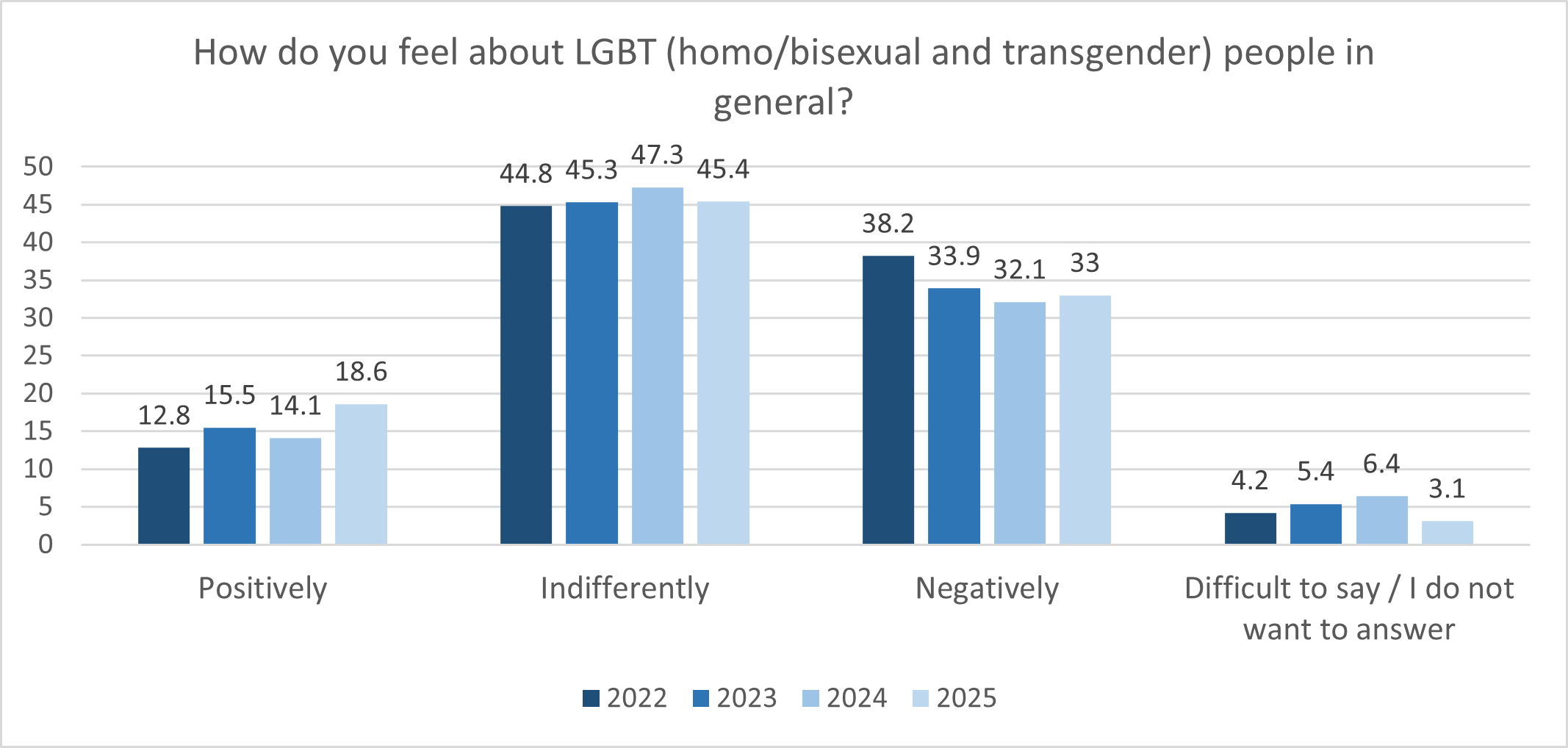
Another public opinion survey, conducted in early October 2025 by the Kyiv International Institute of Sociology (abbreviated as KIIS) at the request of Nash Svit Center, like similar surveys in the three previous years, demonstrated a trend of slow but steady improvement in Ukrainian society’s attitude towards LGBTQ people and the protection of their rights.
In particular, over the past three years, the number of people in Ukraine who have a generally negative attitude towards LGBTQ persons has remained virtually unchanged and is about a third of the population. Meanwhile, the share of those who have a generally positive attitude towards LGBTQ people has increased by 4.5% over the past year, which is a statistically significant indicator. The vast majority (slightly less than half of the population) are indifferent.
At the same time, even a negative attitude towards LGBTQ people does not necessarily mean a denial of their human dignity and rights. Sociologists of the KIIS note, “It is also important to understand that, as before, the category of citizens who have a ‘negative’ attitude towards LGBT people is not actually crystallized consistent opponents. As other survey results have shown, those who have a ‘negative’ attitude towards LGBT people mostly welcome their participation in defending Ukraine from Russian aggression, more than half of them support equal rights for LGBT people, and more than a third are even positive or at least indifferent to the idea of a registered partnership.”
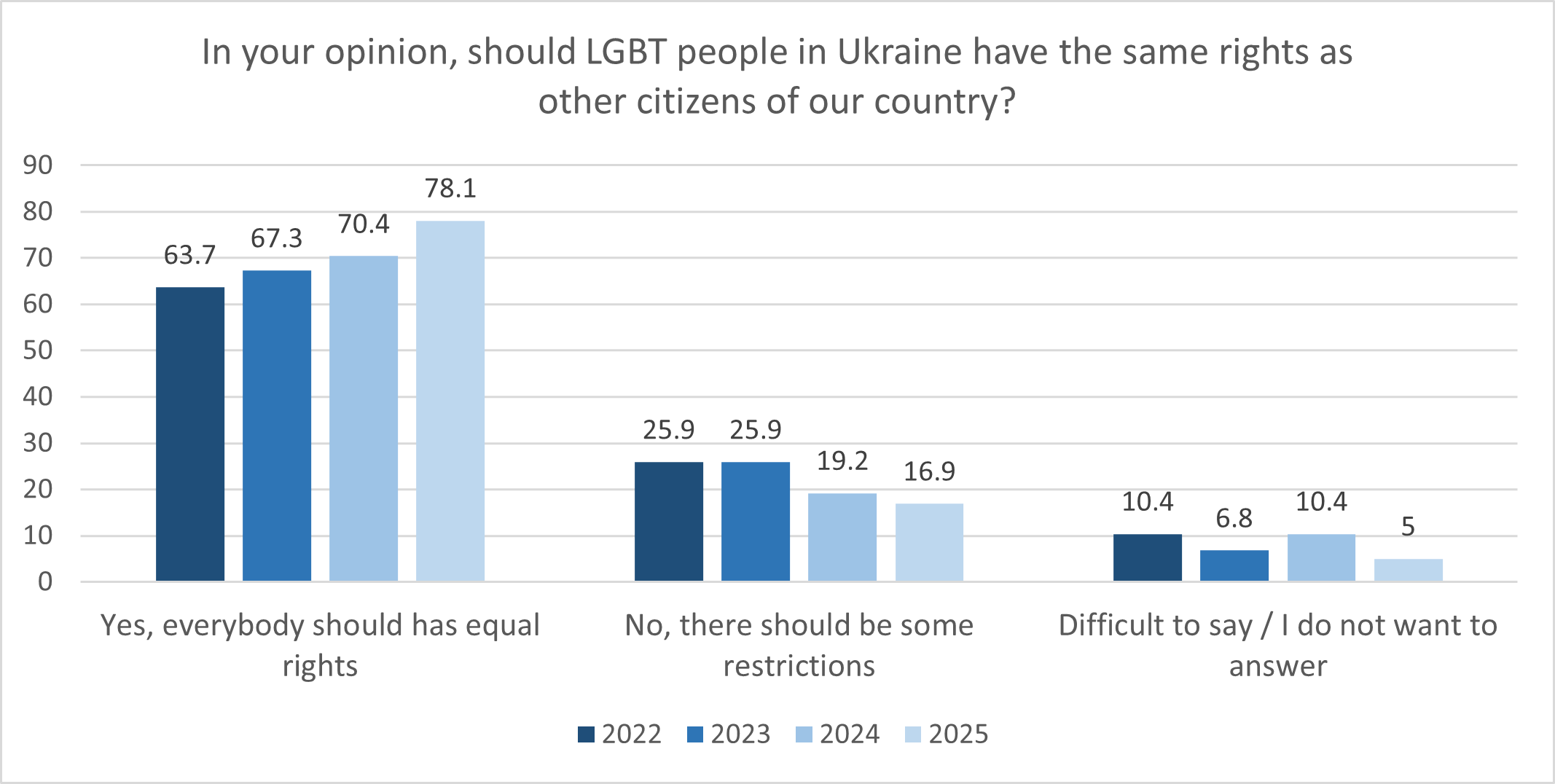
The share of those, who believe that LGBT people should have the same rights as other citizens of Ukraine, in 2025 was 78.1%, which is 7.7% more than in 2024 and 14.4% more than in 2022. This opinion prevails among all socio-demographic categories into which sociologists divided respondents (gender, age, region, type of settlement, education, employment, family well-being), accounting for at least 72%.
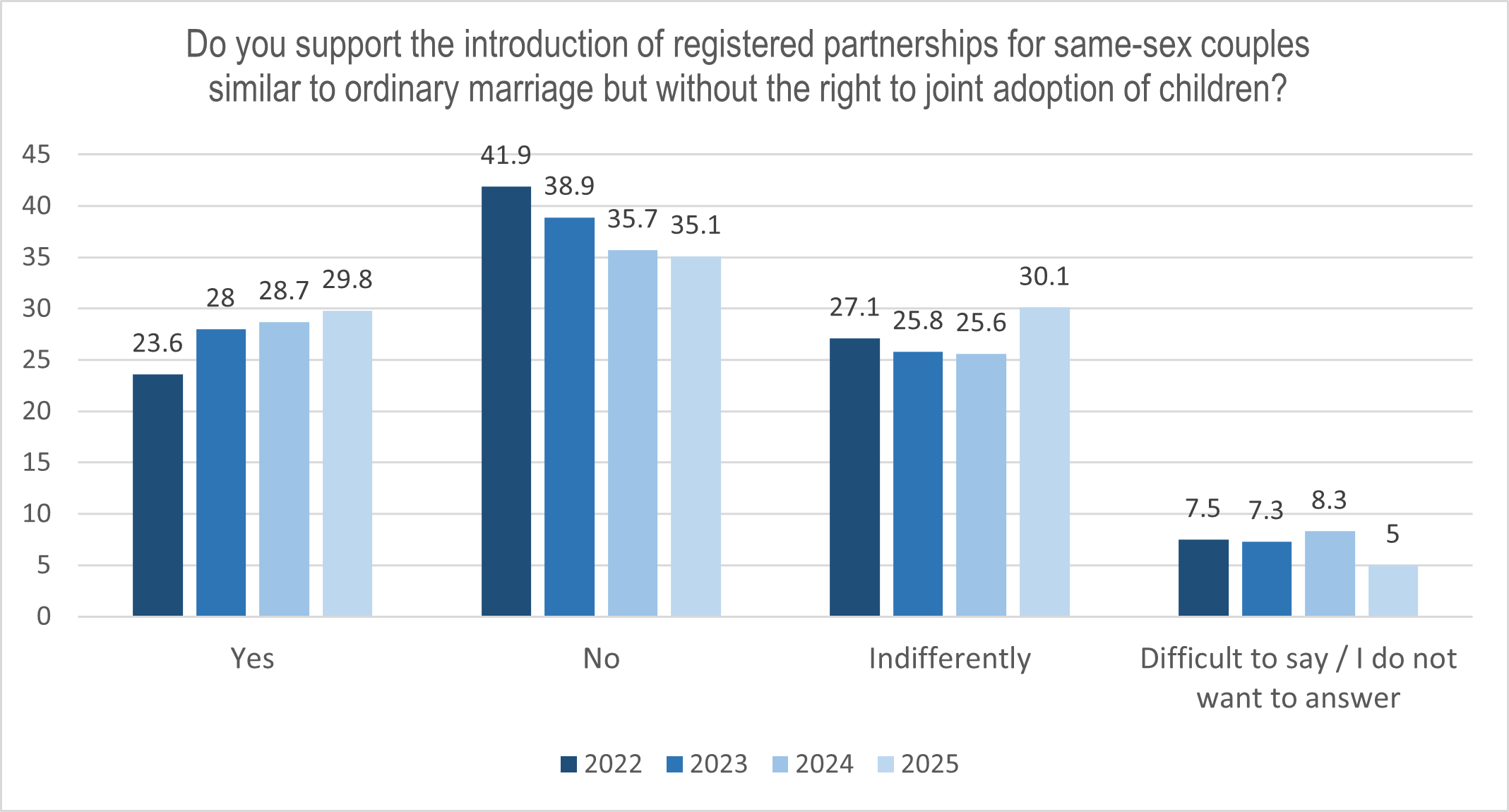
The introduction of registered civil partnerships for same-sex couples in 2025 was supported by 29.8% of respondents, 30.1% were indifferent, and 35.1% were against it. Thus, only slightly more than a third of Ukrainians oppose it now. If in 2022 the gap between those who support civil partnerships for same-sex couples and those who oppose it was 18.3% in favour of the latter, in 2025 it decreased to 5.3%. Among younger age groups, the number of civil partnership supporters already outweighs the number of its opponents (for respondents aged 18-29 — 33.4% versus 29.2%; 30-39 — 40.3% versus 28.4%, respectively).
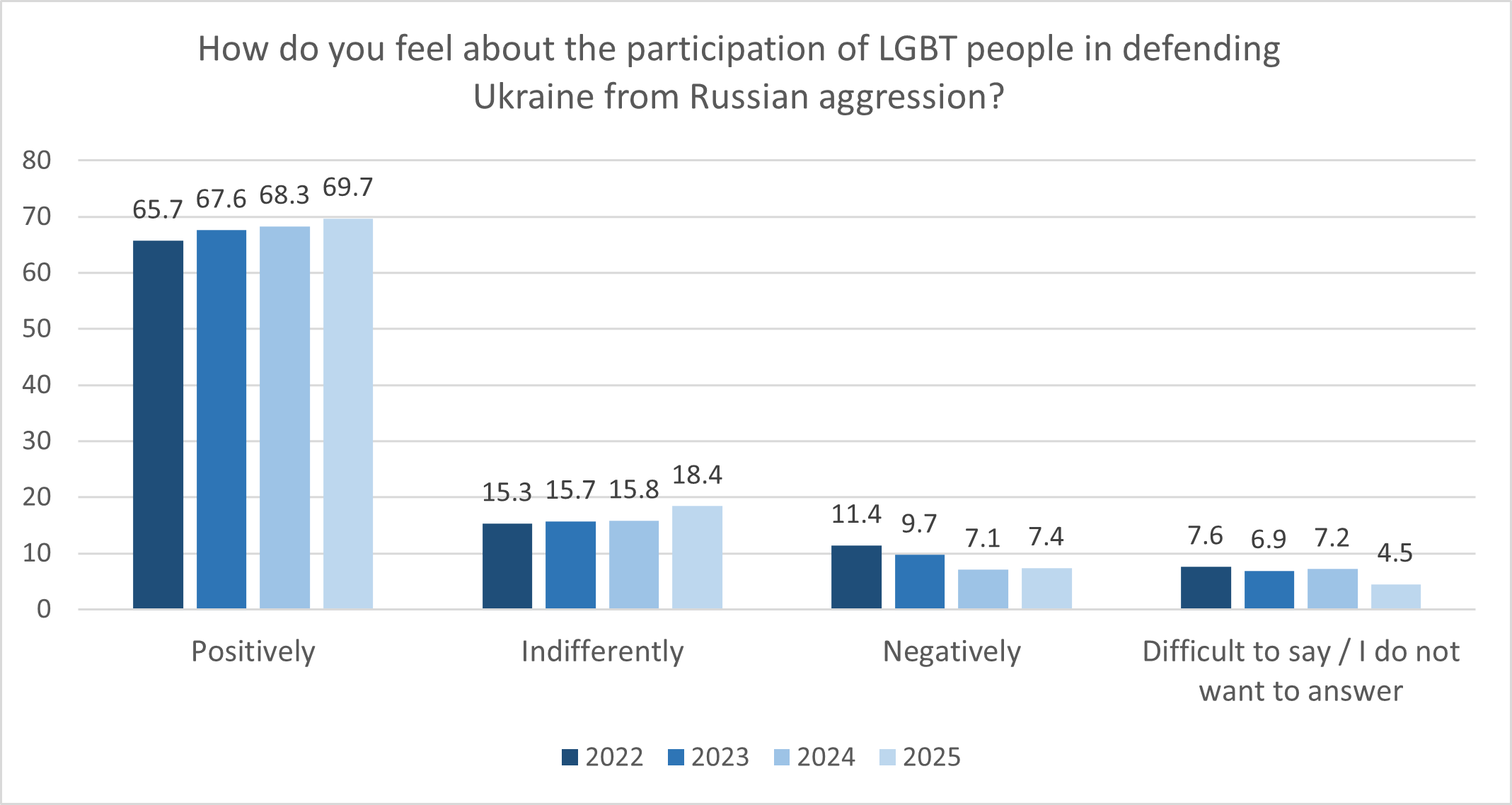
In 2025, about 70% of respondents had a positive attitude towards the participation of LGBT people in resisting Russian aggression. The highest rate of negative attitude was 12% (for residents of villages and Western regions of Ukraine as a whole).
CHURCHES AND RELIGIOUS ORGANISATIONS
Leading Ukrainian churches, united in the All-Ukrainian Council of Churches and Religious Organisations, continue to demonstrate absolute rejection and intolerance towards LGBTQ people, oppose any steps to protect their rights, and avoid public discussions on such topics. However, they are forced to respond to certain events related to LGBTQ issues, the public discussion of which demonstrates both the confusion of church leadership in the face of today’s challenges and an ambiguous attitude towards these issues among ordinary believers and clergy.
In April 2025, the odious Metropolitan Luka of Zaporizhzhya (Ukrainian Orthodox Church of Moscow Patriarchate) appealed to religious leaders of Ukraine to speak out against the Sunny Bunny queer film festival in Kyiv, which this year fell on Easter. Although several unpopular politicians expressed their indignation at such an (accidental) coincidence of a Christian holiday and an LGBTQ event, no one among prominent religious figures responded to Metropolitan Luka’s call, not even his colleagues — bishops of the UOC. It should be noted that currently the UOC (MP) enjoys a very negative reputation in Ukrainian society and religious circles due to its refusal to sever ties with the mother Russian Orthodox Church, and Metropolitan Luka is considered one of its most conservative and pro-Russian hierarchs.
The leadership of the main competitor of the UOC (MP), the Orthodox Church of Ukraine, however, was publicly outraged by the holding of a small rally to protect the rights of LGBTQ people beside the building of the Ministry of Foreign Affairs of Ukraine, which is located near the St. Michael’s Golden-Domed Monastery of the OCU: “The Kyiv Metropolitanate of the Orthodox Church of Ukraine considers the chosen place, time and purpose of this event as a deliberate cynical anti-church provocation aimed at its scandalous advertising.”
However, the attitude towards LGBTQ people in the ranks of the OCU clergy is not so unambiguous. Scandalously known for his far-right and anti-European views, the OCU priest Yaroslav Kulyk expressed the opinion that the Russian attack on Kyiv on June 17 was “God’s retribution” for the LGBT pride march that took place in the capital on June 14, which caused a lot of indignant comments and even theological discussions, including from his fellow priests. At the same time, the priest of the Ternopil Diocese of the OCU, Oleksiy Filyuk, quite popular for his videos on social networks, stated that, although he does not question the biblical teaching about the sinfulness of homosexual marriages and would not agree to marry a same-sex couple, he does not see anything terrible in the very fact of its existence: “If Hanka(i)A diminutive of Hanna, a popular Ukrainian female name. wants to sleep with Hanka, then there is nothing terrible in it. Let her do as she pleases.”
A very large public attention and heated discussions were caused by a Facebook post of Natalia Vorozhbyt (a writer, screenwriter, and director), in which she told that her daughter Paraskeva Kurochkina, who entered the Department of Humanities of the Ukrainian Catholic University (UCU) in Lviv, was denied accommodation in a collegium (a special dormitory) intended for participants in the program “Christian Spirituality in the Postmodern Age.” The reason for the refusal, voiced in a telephone conversation by a representative of the university, was that few years ago Paraskeva had posted on her Instagram page an emoticon of a rainbow flag. Natalia Vorozhbyt stated that she and her daughter were deeply offended by this attitude from the university administration, but decided not to file an official complaint, and Paraskeva Kurochkina refused to enter UCU and instead became a student at the Kyiv-Mohyla Academy.
This incident was so widely covered by the Ukrainian media and hotly discussed on social networks that the university administration was forced to publicly respond to it and apologize twice to Vorozhbyt and Kurochkina, but only for poor communication. The public was divided in their attitude towards the incident and the homophobic views of the UCU leadership and the Ukrainian Greek Catholic Church as a whole, which owns this educational institution. Many believers of the UGCC stated that they do not share the extremely negative and uncompromising attitude of their church towards LGBTQ people, which cannot be justified by adherence to biblical doctrine.
This case also drew attention to the legal problems of protection against discrimination and ensuring freedom of religion in Ukraine. The law “On the principles of preventing and combating discrimination in Ukraine” provides that the general principle of prohibiting restrictions on rights and freedoms on certain grounds may contain exceptions “when such a restriction has a legitimate, objectively justified goal, the means of achieving which are appropriate and necessary.” Theoretically, a police investigation and/or a court should have established whether the restriction of Paraskeva Kurochkina’s rights by the UCU leadership was justified in this case. However, the victim’s refusal to file an official complaint does not create legal grounds for considering this incident in civil proceedings. Currently, Ukrainian legislation contains a single provision on punishment for discrimination that can be applied in such cases – Article 161 “Violation of the equality of citizens depending on their racial, national, regional affiliation, religious beliefs, disability, and on other grounds” of the Criminal Code of Ukraine. However, it is the object of a private prosecution — that is, the police can only initiate a criminal investigation under this article if there is a complaint from the injured party.
It is typical that neither the sharp criticism from its own liberal believers nor the noticeable softening of the attitude towards LGBTQ people by the leadership of the Catholic Church as a whole has so far affected the irreconcilably hostile attitude towards them from the leadership of the UGCC, which is shared by the rest of the leading Christian denominations of Ukraine. On September 17, the Head of the UGCC, Major Archbishop Svyatoslav, headed a regular meeting of the Council of Christian Churches of Ukraine — a consultative and advisory body created by the leaders of Ukrainian Christian churches to represent and coordinate their activities. Its participants once again repeated the Kremlin narratives, emphasizing “the importance of protecting public morality in Ukraine during the war and the inadmissibility of adopting laws that, in fact, are aimed at destroying the institution of the family and restricting freedom of expression under the slogan of ‘fighting discrimination’” — that is, the adoption of any laws and decisions aimed at protecting the rights of LGBTQ people.
LGBTQ COMMUNITY
The main tasks of the Ukrainian LGBTQ movement since the beginning of the full-scale invasion remain participation in the resistance to Russian aggression and survival in war conditions as well as advocacy for the adoption of laws and policies to protect LGBTQ rights as part of Ukraine’s accession to the EU.
On the initiative of the co-founder and first chairman of the NGO “Ukrainian LGBT+ Military and Veterans for Equal Rights” Viktor Pylypenko, the general meeting of the organisation elected its new chairman Oleksandr Demenko, a defender of Azovstal who spent 20 months in Russian captivity. Viktor Pylypenko was elected his deputy, Chairman of the Executive Committee. In 2025, “Military LGBT+” continued its advocacy activities to protect the interests of LGBTQ military personnel and the entire Ukrainian LGBTQ community, but also began to engage in specific human rights activities. In particular, thanks to their legal support, Evelyn Aschenbrenner, a non-binary person from the USA (pronouns they / their), who served in the International Legion from March to December2022, where they faced transphobic attitudes from the battalion command, was able to achieve concrete solutions to correct the situation: the leadership of the International Legion were informed and instructed to prevent discrimination, and the chief of staff of the relevant military unit was brought to disciplinary responsibility and demoted.
Following a complaint by the “Military LGBT+” about discriminatory actions by the printing house Dominanta-tekstil (they refused to print the organisation’s flag), the Secretariat of the Ukrainian Parliament Commissioner for Human Rights warned the management of the printing house about the illegality of their actions and suggested eliminating the identified violations. More effective was the appeal by the “Military LGBT+” to the National Council for Television and Radio Broadcasting with a complaint about the homophobic publication of the website “Vsi razom!” about the aforementioned incident with the printing house — the national media regulator imposed a fine of UAH 40,000 on the violator.
The first major study of the situation of LGBTQ people in the Ukrainian military, conducted with the support of the NGO “Ukrainian LGBT+ Military and Veterans for Equal Rights,” identified the problems faced by Ukrainian LGBTQ military and veterans and drew public attention to them.
The LGBTQ movement has significantly intensified its activities in Western Ukraine, where it was previously almost invisible due to the hostile attitude of local authorities as well as churches and radical right-wing organisations influential in this conservative region. Although the latter do not give up attempts to disrupt any LGBTQ events, thanks to effective police protection the NGO Insight managed to successfully open a community centre in Ivano-Frankivsk. In Lviv, albeit on the second attempt, for the first time in recent years NGOs Feminist Workshop and Bilkis managed to hold a public mass action to protect the rights of the LGBTQ+ community “To be yourself is a right.”
Similarly, thanks to the active actions of the police, radical right-wing activists in Lviv did not manage to completely disrupt the presentation of book by Alina Sarnatska “Who united love and courage” about the experience of LGBTIQ+ people in the war, organised jointly by the publishing house Vydavnytsvo and the NGO ALLIANCE-GLOBAL. However, due to the obvious threat from their aggressive opponents, the participants of the presentation had to be evacuated under police protection after its conclusion.
Queer Film Festival Sunny Bunny this year took place without any notable incidents. The police provided its constant security and blocked a group of aggressive young men under the flags of far-right groups who tried to disrupt its opening.
The Equality March 2025 in the Ukrainian capital, organised by KyivPride, was more massive and longer than last year. It is worth noting the hard work of its team with local authorities and the police, thanks to which it became possible to hold this and several other events within the framework of Pride Month — representatives of the Kyiv administration and law enforcement agencies, traditionally, tried not to ensure freedom of peaceful assemblies for the LGBTQ community, but to dissuade the organisers from holding those events, intimidating them with possible terrorist acts by aggressive radical right-wing opponents and shifting responsibility for their possible consequences from the aggressors to their potential victims.
KharkivPride was also quite noticeable and successful. After the start of the full-scale Russian invasion, its organisers refused to hold the traditional Equality Marches due to the excessive danger of public mass gatherings in a frontline city, but every year they find formats of actions that are able to demonstrate the life of the Kharkiv LGBTQ community even in such harsh conditions. In 2025, the KharkivPride program included the charitable and educational PrideFest, an event honouring the memory of fallen LGBTQ+ soldiers, and AutoPride which drove through the streets of the city.
Both within the framework of pride events and in their daily activities, all leading Ukrainian LGBTQ organisations are constantly raising funds to support resistance to Russian aggression. Thanks to international assistance, some LGBTQ organisations support the activities of shelters for internally displaced persons, provide material, financial and psychological assistance to those affected by military actions.
One of the main themes of the vast majority of public LGBTQ events and activities of the Ukrainian LGBTQ movement in 2025 was advocacy for the adoption of legislative changes to protect LGBTQ rights, and primarily, bills on the criminalization of hate crimes and on registered civil partnerships. Ukrainian LGBTQ and human rights organisations have agreed on their positions and are conducting a coordinated campaign to include these issues on the agenda of the Ukrainian authorities within the European integration process.
2. Violence, discrimination and other violations of LGBTQ rights
(i)In this section, the number of documented violations of LGBTQ people’s rights may apparently exceed the number of cases, because some cases involve several violations.From January to September 2025, the monitoring network of Nash Svit Center documented 44 cases of actions based on homophobia / transphobia, discrimination and other violations of rights on SOGI grounds in Ukraine. The distribution of documented cases by region was as follows (please see Table 1):
Table 1
Actions based on intolerance towards LGBTQ people by private individuals or groups
The largest number of cases (23) involved homophobic and transphobic acts by private individuals or groups. According to the OSCE classification, 13 of them can be characterized as hate crimes, 9 as hate incidents, and 5 cases involved hate speech.
The following types of violations were noted (please see Table 2):
Table 2
As in the past year, the level of aggressive actions by representatives of radical far-right and conservative groupings against LGBTQ centres / events or activists, as well as businesses supporting the ideas of equality, remains significant. Organisations such as KyivPride, KharkivPride, and the NGO Insight, as well as the bookstore Sens in Kyiv which held presentations of queer-themed publications, were targeted. Thus, at the end of September, Sens, located near Arsenalna metro station, was twice attacked by young men from the ultra-conservative group Shield of Tradition. The champions of “traditional values” did not bypass café Vibrokavyarnya in Kyiv (in particular, they did not like the pillows with images of gay actors) — having visited the establishment, they declared that they were “engaging in censorship in Ukrainian society” and threatened to arrange a “Kristallnacht” for those who did not listen to their instructions. Also in January-September 2025, activists from groupings such as Prava molod (“Right-wing Youth”), Krovna Yednist (“Blood Unity”), Tryzub (“Trident”), Bratstvo (“Brotherhood”) and Karpatska Sich (“Carpathian Sich”) were noticed in attacks on LGBTQ centres / events.
At the same time, it is worth noting the decrease in recorded cases of physical violence compared to the same period last year (9 versus 24).
Mixed-type hate crimes (fake dates), when the victims are chosen for extortion or robbery precisely because of their sexual orientation, remain an unchanging trend.
Interaction with law enforcement agencies
In 20 cases, the interaction of victims with law enforcement agencies was noted (calling the police, filing reports of offenses, conducting investigative actions, etc.). In 6 of them, cases of violations of LGBTQ people’s rights by law enforcement officers were documented (please see Table 3):
Table 3
Case 2413
At the end of August, a gay man who underwent extortion because of his sexual orientation filed a report of the crime with the Pechersk District Police Department of Kyiv. The report was accepted, however, he was told that he had to drive to the crime scene, but instead of this he was taken to the local military recruitment centre, and the next day he ended up at the army training centre.
When a couple of days later he tried to find out by phone whether criminal proceedings had been opened on his application (this should have been done automatically within 24 hours – Article 303 of the Criminal procedural Code of Ukraine), he was told that there would be no proceedings, since the bank that owned the fraudsters’ card refused to disclose personal information without criminal proceedings. “And in general,” said the operative who allegedly conducted the check, “how do you imagine we will conduct investigative actions without you? No one will go to your military unit.”
Thus, by violating the law, the police not only deprived the victim of effective legal protection, but also actually allowed a criminal group to continue its illegal activities.
Violations in the Armed Forces of Ukraine (military offenses)
In the first nine months of 2025, 5 cases of human rights violations based on SOGI were documented in the Armed Forces of Ukraine (please see Table 4).
Table 4
In three cases, servicemen were subjected to discriminatory pressure and persecution by their command for publicly expressing their civic position regarding the attitude towards LGBTQ people in the army and equality. All of these situations were more or less resolved only by personally contacting the gender advisor of the Ministry of Defence through the NGO “Ukrainian LGBT+ Military and Veterans for Equal Rights.”
In one case, a servicewoman was subjected to sexual violence by a drunken comrade-in-arms who wanted to “correct” her sexual orientation.
In the educational sphere, 3 cases of discrimination based on SOGI were documented, including:
- eviction and refusal to settle in a dormitory due to the sexual orientation of female students (2 cases);
- disclosure of confidential information about the sexual orientation of a high school student by a teacher and, as a result, the student’s harassment by other children.
In the field of providing goods and services, 3 cases of discrimination on SOGI grounds were documented, which consisted of refusal of service, insults, humiliation of human dignity, threats, and intrusion into personal life.
In the employment sector, 2 cases of violations of labour rights on SOGI grounds were recorded, which consisted in the dismissal of victims due to harassment by colleagues and management.
Violations by the occupying authorities in the temporarily occupied territories
In occupied Crimea, at least 5 cases of administrative liability for the so-called “propaganda of non-traditional sexual relations” (Article 6.21 of the Code of Administrative Offenses of the Russian Federation) were recorded, which provides for fines from 50,000 to 100,000 RUB. In particular, a woman in Kerch was fined under this article for a post on a social network about the emancipation of heterosexual men, which she illustrated with a meme of a man in a wedding dress.
©LGBT Human Rights Nash Svit Center, 2025
E-mail: [email protected]
Website: https://gay.org.ua/
Facebook: https://www.facebook.com/nashsvitcenter
Instagram: https://www.instagram.com/nashsvitcenter
When using the report’s materials, a reference to Nash Svit Center is mandatory.


This report was produced with the financial support of the European Union and the Council of Europe. Its contents are the sole responsibility of the author. The views expressed herein can in no way be taken to reflect the official opinion of either the European Union or the Council of Europe.